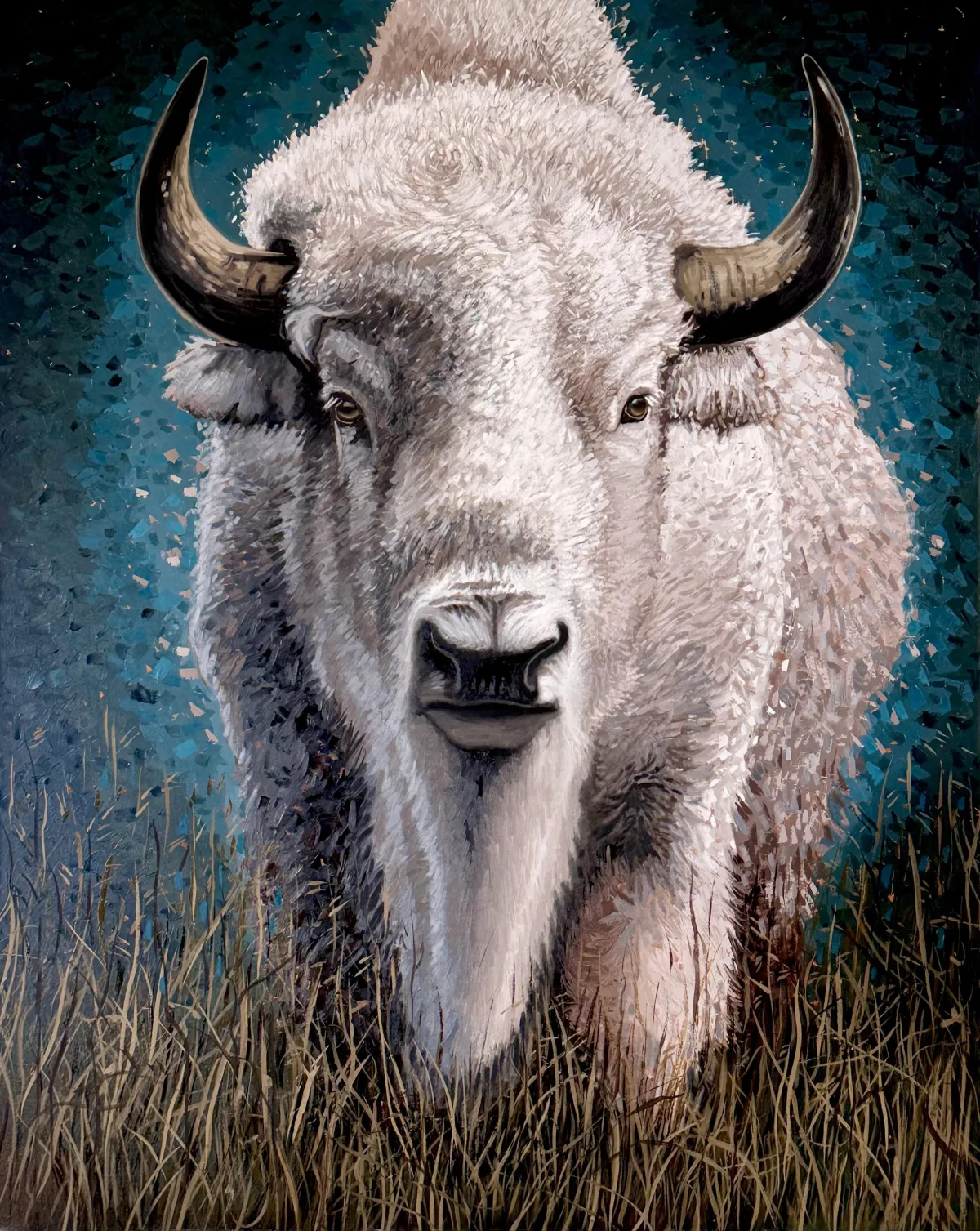
He Stands When All Bow
He Stands When All Bow is a piece that demanded a particular eye for detail. It required that I carefully consider, not only the enormity of the project for Marcella Vision, but also the sacred nature
of the subject matter that would be shared with potentially thousands of family, friends, patrons of the show, top designers, and potential art collectors. No pressure - right?
Knowing this is a marquee piece that will stand at the portal of nearly the entire collection of Marcella Vision, I knew I needed to tackle this early on. With a potential to set the tone, He Stands needed to
be a true show stopper. Of course, beauty is in the eye of the beholder, but it has profound significance to the Astill family and stands as a hallmark of succeeding work you will see at this amazing property.
Its power derives from an exploration of authority, not through force, but through obedience. With a Divine posture of resilience, the bison resists spectacle and instead invites calm reverence. In ancient tradition, the bull symbolized strength restrained by order – power that listens before it moves. It was closely aligned with the idea of divine order. Here, that idea becomes central.

The palette follows a resurrection arc. Earth tones and ash-gray undertones give way to ivory
and white, not as absence, but as completion. White functions as fulfillment rather than purity
alone—the visual resolution of sacrifice, judgment, and covenant. The surface carries both weight
and restraint, allowing the texture to speak without noise.
In The Lord of the Rings trilogy, Gandalf passes through death and returns “in white”—not as a costume change, but as a transformation of authority. That image has always stuck with me: the movement from burden into brightness, from struggle into clarified purpose. In that sense, this
bison becomes a quiet echo of resurrection—still, watchful, and newly established.
Subtle structure undergirds the composition. The proportions of the horns, eyes, and mouth
echo sacred architectural order, suggesting alignment rather than dominance. The eyes carry
judgment—not condemnation, but discernment. The horns hold covenant and continuity. The
mouth, quiet yet present, becomes a place of obedience: the Word received, not proclaimed.
This work is Color Chorded to So Will I (100 Billion X) - Hillsong, a song that frames creation as
an act of listening. The rhythm suggests a measured cadence—like a distant hoofbeat—while the progression moves from humility into glory. The painting mirrors that movement visually, resolving
into still authority rather than action.
Placed at the landing of the stairs in the Marcella Vision property, He Stands When All Bow
functions as an anchor within the home. As one ascends, the work asks for pause. As one passes,
it offers orientation. Strength stands—not because it resists—but because all else bows. That stillness is not accidental.
The Pattern Beneath the Image
Beneath the surface of the image is an order that cannot be seen at first glance. Strength, in ancient thought, was never chaotic—it was aligned. What appears intuitive in the painting is, in fact, patterned.
The composition of He Stands When All Bow is informed by the architectural order of Solomon’s Temple. The proportions of the bison’s head—its mouth, eyes, and horns—intentionally mirror the tripartite structure of the temple: the Outer Court, the Holy Place, and the Holy of Holies. This pattern
is not decorative. It describes a process of approach.
The Outer Court aligns with the mouth. This is the place of the Word, sacrifice, and obedience.
Entry begins not with power, but with willingness. Strength that cannot obey cannot move inward.
The Holy Place corresponds to the eyes. This is the space of discernment and judgment, where
light reveals what is true. Nothing passes further without being seen clearly and weighed honestly.
The Holy of Holies is reflected in the horns. In ancient tradition, horns signified covenant, authority, and power bound by promise. Here, strength is no longer tested or restrained—it is established. Covenant is made, and rest follows.
This inward movement—from obedience, through judgment, into covenant—reflects the logic of
sacred space and sacred authority. Power is not seized. It is approached, examined, and finally granted.
The bison stands still because it has already passed through the pattern.

Diagram Legend
OUTER COURT
Word · Obedience · Sacrifice
HOLY PLACE
Judgment · Discernment · Light
HOLY OF HOLIES
Covenant · Authority · Rest
Read Part II - For the One Never Left Behind
